
Returning to the Frequency
There are parts of the story I’ve shared publicly, and parts I haven’t.
This is somewhere in between.
For a long time, I thought the exhaustion I was carrying was just adulthood. Responsibility. Maturity. I had built a life that looked structured and impressive on paper. I could adapt. I could perform. I could move between worlds - creative, corporate, disciplined, service-oriented - without missing a beat. From the outside, it looked like range. From the inside, it felt like fragmentation.
What I didn’t realize at the time was that I had drifted from the frequency that first made me feel alive.
When I was studying fine arts at Mount Allison, the magic wasn’t the syllabus. It was the late-night conversations. The studio energy. The feeling of being surrounded by people who were thinking deeply and feeling openly at the same time. When I was at Oxford Brookes, it wasn’t the title of the degree that mattered. It was the exchange. The sharing of process. The critique that felt like curiosity instead of competition. The quiet electricity of being in a room with others riding the same creative wave.
There’s something that happens when kindred creatives gather.
You feel it in your nervous system.
You feel it in your bones.
It’s not ego. It’s not performance. It’s not networking.
It’s recognition.
Somewhere along the way, I stepped off that path. Not in a dramatic way. More like a side quest. Bartending. Military structure. Roles that required resilience and discipline and adaptability. None of it was wrong. But over time, I realized I was surviving more than I was creating. And then something shifted. Through an unexpected creative connection - one built on shared books, shared songs, shared process - I felt that frequency again. Resonance. The kind that reminds you of who you are without asking you to prove it. We exchanged drafts from our ongoing creative pursuits, swapped the books and podcasts that fed our process, and spoke about ideas as if they were living things. It wasn’t about output. It was about alignment. It reminded me that creativity is not a hobby for me. It’s a current. And when you’re around someone else who can tap into it with you, the current strengthens.
But here’s the part that matters most: It wasn’t just about being around creative people. It was about showing up unarmoured. Safe enough to be raw. Honest enough to admit confusion. Mature enough to release ego. Willing to be seen without performance. That kind of connection doesn’t just spark ideas. It heals you.
It reconnects you to the version of yourself that existed before you started proving anything.
I began to see that what I had been calling “burnout” was misalignment. What I had been calling “breaking” was recalibration. The armour that once protected me had grown heavy.
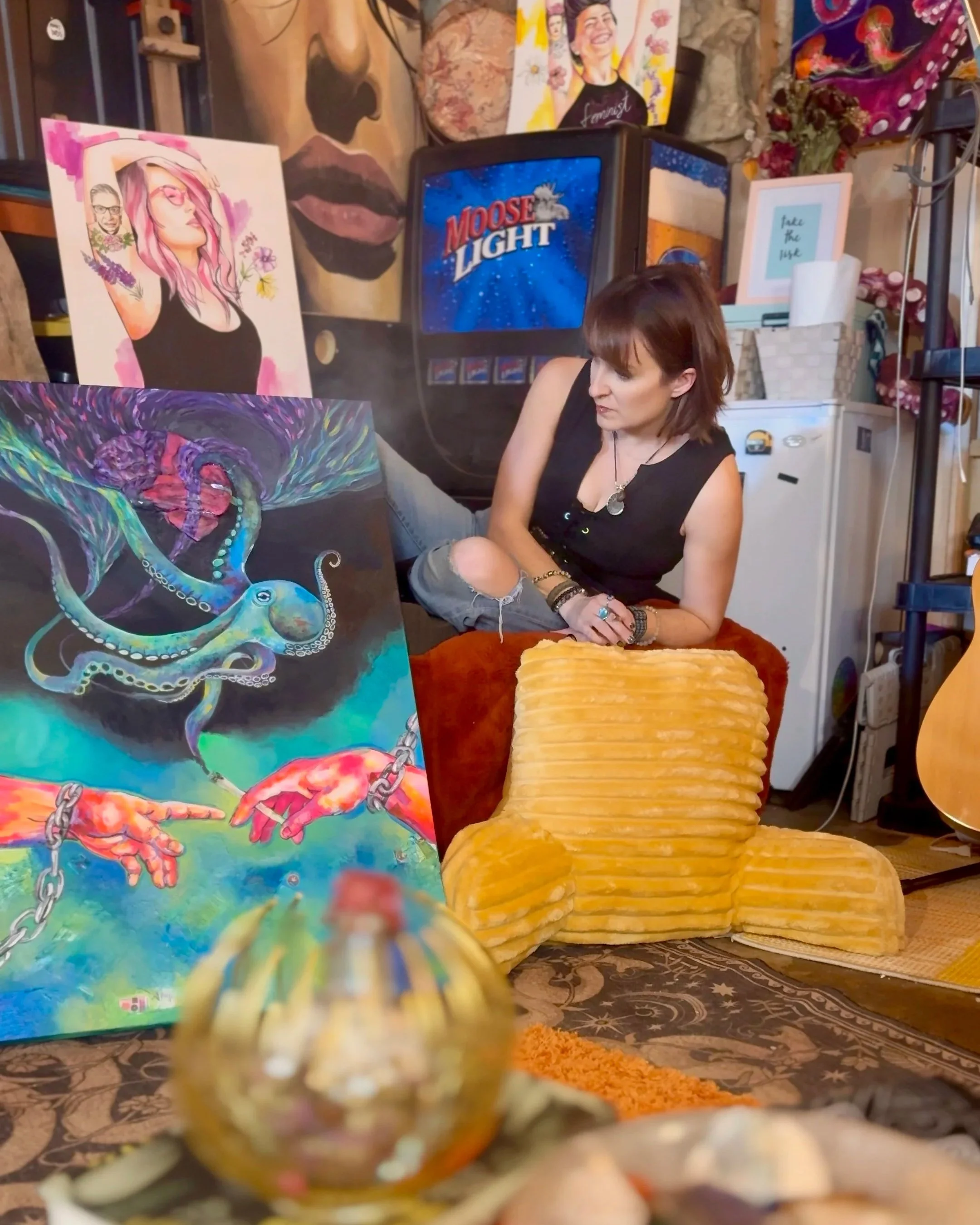
There was a physical shift that happened alongside the internal one. I moved my studio space into the garage. That sounds small. Logistical. Practical. It wasn’t.
For years, I tried to create in the spare room of the house but I couldn’t shake the old wiring that told me creative mess was something to apologize for. Even when no one was asking me to clean it up, I felt the pressure to contain it. I realized I needed a space where shame could die.
Shame about mess.
Shame about unfinished work.
Shame about returning to parts of myself I once boxed up.
The garage gave me that. Concrete floors. Open air. No expectations of polish. A place where I could experiment without feeling like I was disrupting something. That shift was suggested by someone who saw what I couldn’t at the time - that I needed physical distance from the structures that had quietly trained me to perform. So I dragged everything out. Old canvases. Sketchbooks from university. Pieces from my early twenties. Paintings I hadn’t looked at in years.
I even pulled out my five Spice Girl dolls - still pristine in their original packaging. For a moment, I laughed at myself. And then I understood. It wasn’t about nostalgia. It was about reclamation. I needed to see the full timeline of myself in one room… the child, the art student, the side quest survivor, the woman returning.
In that garage, nothing had to be curated. Nothing had to be impressive. Nothing had to be monetized. It just had to be honest. There’s something powerful about giving yourself a room where you are allowed to be unpolished. A room where experimentation matters more than outcome. A room where you’re not managing perception. That space became more than a studio. It became proof that I was done creating inside containers that didn’t fit me.
Creativity didn’t save me because it made me successful. It saved me because it brought me back into integrity. And from that place, something else became clear: Not everyone gets access to this process. Not everyone gets access to the parts of you that are still forming. Not everyone gets access to your nervous system.
Protecting my energy stopped feeling selfish. It started feeling sacred.
This space was born from that realization.
Not as a reaction. Not as a rebellion. But as a realignment.
I’m not abandoning the chapters that came before. Even the side quests shaped me. They built resilience. They taught discipline. They introduced me to parts of myself I wouldn’t have otherwise met. But this is the chapter where I choose to live in alignment with the frequency I’ve always known was mine. The one I felt as a child. The one that hums when I’m writing. The one that grows stronger when I’m in honest creative exchange with others. The one that quiets when I start performing. If you’re here, you may know that hum too. And maybe you’ve drifted from it. Maybe you’ve built armour that once served you but now feels heavy. Maybe you’re realizing that alignment isn’t about changing who you are. It’s about returning to who you’ve always been.
This isn’t a dramatic reinvention. It’s a steady realignment. And I’m protecting it this time.