
The Unravelling That Lead Me Back
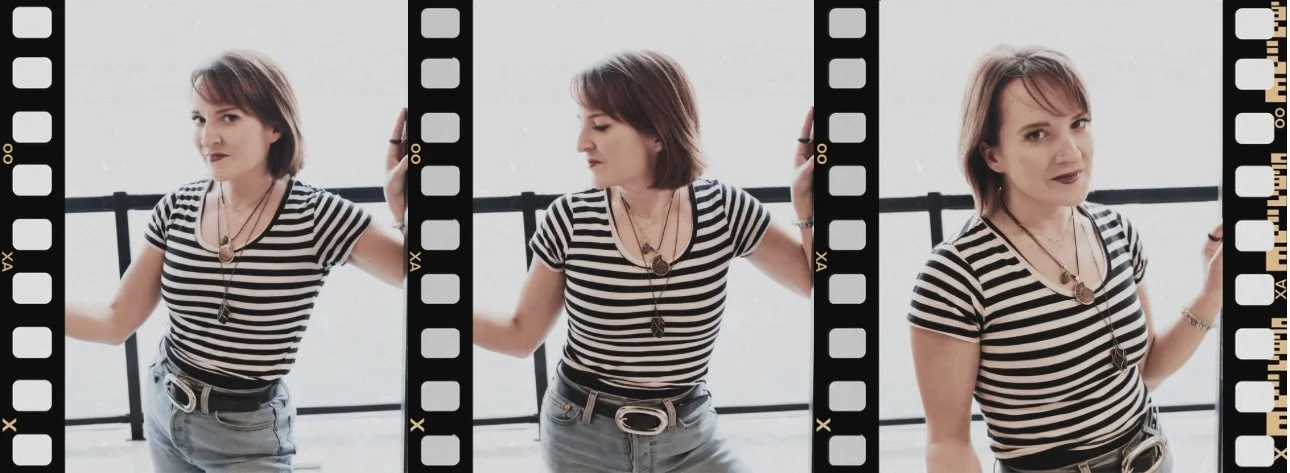
I didn’t find spirituality in a church. I found it in the wreckage.
But that’s not where my story starts.
I was raised Catholic—a framework handed to me before I knew I could ask questions. I followed it the way most of us do as children—absorbing, repeating, trusting.
It wasn’t until I left my small town at eighteen and went off to university in the neighbouring province, that something cracked open. A professor introduced me to something deceptively simple: critical thinking. Not what to think… but how. Biases. Conditioning. Questioning the source. Questioning the system. Questioning everything. And just like that, the foundation I stood on started to shift.
I went through an brief atheism phase—though looking back, it felt less like a conviction and more like trying on an identity the way we do when we’re figuring out who we are. Because that’s what we’re taught to do, isn’t it? Attach. Label. Belong.
But that phase didn’t last long. Because somewhere in the quiet, I realized something humbling: I was smart enough to know that I don’t know. And there’s a quiet strength in that. A kind of surrender that isn’t weakness… it’s honesty. So I softened into agnosticism. Not a rejection but an opening. A knowing that something exists beyond what we can explain, but no desire to confine it to a box, a label, a doctrine that claims superiority over another. Because if history has shown us anything, it’s that certainty (especially righteous certainty) has been the seed of so much division.
All I knew (long before any of this) was what it meant to feel. I have diary entries from my childhood (messy, preteen handwriting) about the weight I carried watching others be bullied, feeling the injustice of it in my body. I didn’t have language for empathy back then. Or sensitivity. Or nervous system responses. But I felt it. Deeply.
And somewhere along the way, I learned to armour up against it. It wasn’t until everything started to fall apart that I began to come back to myself.
Not through belief—but through healing. Unshackling. From expectations. From systems. From roles I had learned to perform just to feel safe. I had to unlearn who I was before I could remember who I am. I had to sit with my anxiety long enough to understand what was actually mine and what was inherited, absorbed, conditioned.
And in that quiet process of the, messy, nonlinear work of healing, something unexpected happened. I met my intuition again. Not as a concept—but as a voice. A knowing. The gold beneath the armour. And with it… my spirituality. Not something taught. Not something prescribed. Something remembered.
And here’s the part I can’t ignore anymore: It shouldn’t be this hard to come home to yourself.
It took me decades to find my voice after a lifetime of believing it didn’t matter. So many people don’t get that chance. Not because they don’t have a voice but because they’re still shackled to systems that were never built with them in mind. A one-size-fits-all world that punishes difference instead of making space for it.
And we see the cracks now.
In education.
In mental health.
In the way people are quietly falling through the gaps because they don’t fit the mold.
Take something like aphantasia which is the inability to visualize in the mind’s eye.
I didn’t even know it existed until adulthood. And chances are, if you do know the term, it’s something you stumbled upon recently too, either through conversation, curiosity, or the strange connective tissue of the internet.
As an artist with an overactive mind’s eye (one that has, at times, overwhelmed me as much as it’s inspired me) I found this deeply fascinating. And suddenly, everything reframed.
One of the reasons I thrived in school was because I could see everything in my mind: memorize, replay, regurgitate. But what about the ones who can’t? What about the ones navigating trauma—visible or invisible? What about the kids whose minds were never designed to learn, focus, regulate, or communicate in the standardized ways we demanded of them? The ones labeled “too much,” “too distracted,” “too sensitive,” or “too difficult” before anyone stopped to ask what was actually happening beneath the surface?
What about the highly sensitive kids (like I was) feeling everything without the language or tools to understand it? Why are so many people being measured against systems that were never designed with their nervous systems, minds, or ways of experiencing the world in mind?This is where my purpose lives now.
In the space between healing and advocacy. In using the voice I fought so hard to reclaim to speak for those who are still finding theirs. To challenge systems that demand conformity at the cost of humanity.
To remind people: There is nothing wrong with you for not fitting into something that was never built to hold you.
And creativity is the thread that saved me. Not the kind that performs. Not the kind that produces for approval or profit. But the kind that listens. The kind that lets you play, explore, create without needing it to be anything at all. Even artists have been shackled—taught to create what sells, what’s digestible, what fits.
But creativity was never meant to live in a box. It’s a language. A portal. A return. And when we reconnect with it authentically (not performatively) we begin to heal.
I don’t have all the answers. I don’t need to anymore.
But I know this: Healing yourself is not selfish.
It’s the beginning of everything. Because when we come home to ourselves—to our intuition, our creativity, our truth—we don’t just change our own lives.
We become part of the shift that heals the world.